
9 July, 2026
Sports are not an extracurricular addition to school education; they are an essential part of a child’s holistic growth – central to how children grow, learn, relate, lead and build resilience. In a world where children are spending more time indoors and on screens, school sports and physical education offer something deeply valuable: movement with purpose, effort with joy, and competition with character.
Global research elucidates this. The World Health Organization states that physical activity in children and adolescents supports bone health, muscular fitness, healthy growth, motor development, cognitive outcomes and mental health. WHO guidelines also recommend that children and adolescents should average at least 60 minutes of moderate-to-vigorous physical activity daily. UNESCO’s Quality Physical Education framework places physical education at the heart of developing healthy, resilient and socially responsible citizens.
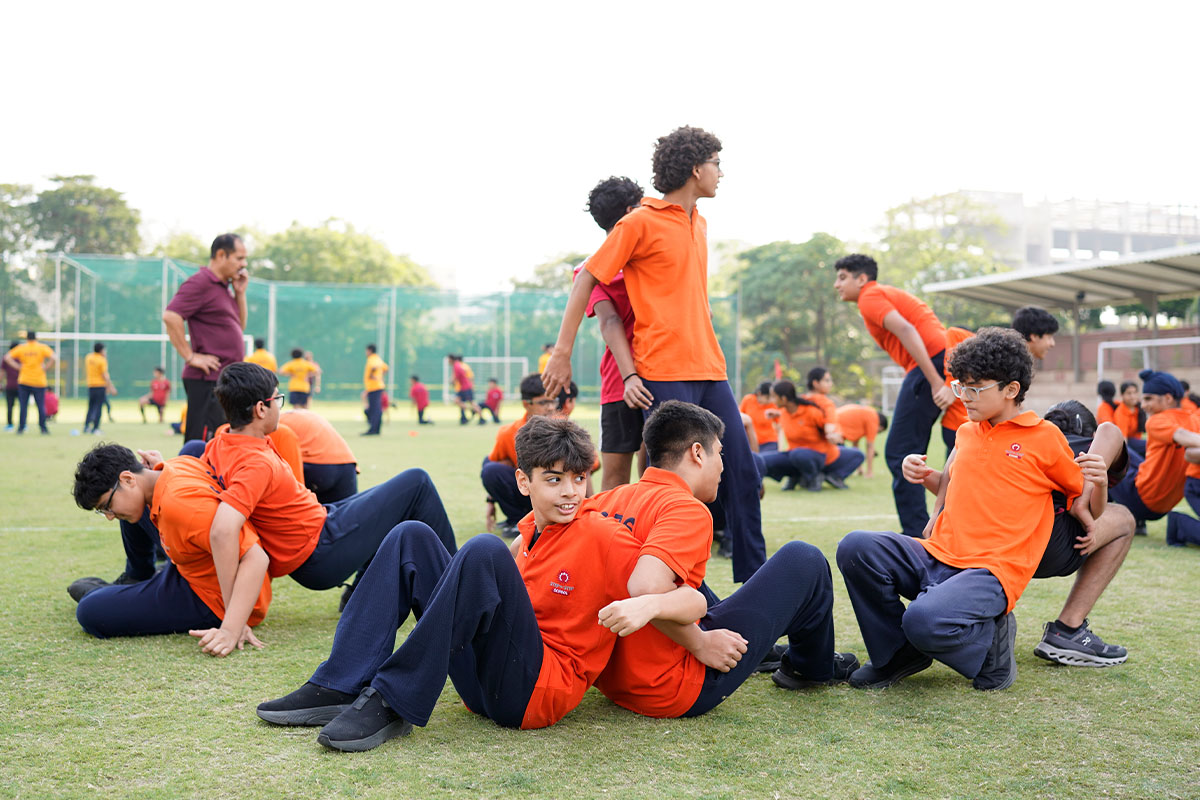
The most visible benefit of school sports is improved physical fitness. Regular participation in games, athletics, swimming, gymnastics, football, basketball, yoga or fitness drills helps children develop strength, stamina, flexibility, balance and coordination.
Physical fitness for students doesn’t just make them active, it also supports heart health, bone strength, muscular development and healthy body composition. Children who move regularly also build better motor skills, posture and body awareness. This becomes especially important during the growing years, when habits formed in school can shape lifelong health.
A strong school sports programme equips every child with the opportunity to move, not just the naturally athletic ones.
Sports give children a healthy outlet for stress, anxiety, restlessness and emotional overload. Movement helps students release energy, regulate emotions and return to learning with a calmer mind.
WHO evidence links physical activity in children and adolescents with positive effects on mental health, cognitive function and academic outcomes. The benefit is not limited to competitive sport. Free play, structured physical education, team games, individual sports and active classroom breaks all support student wellbeing.
On the field, children learn that effort can be difficult and enjoyable at the same time. That lesson stays with them.
A common misconception is that sports take time away from academics. Research suggests the opposite. The CDC notes that classroom physical activity can improve student academic performance and behaviour. A National Academies review also found that increasing physical activity and physical fitness may improve academic performance, and that time dedicated to recess, physical education and classroom activity may support learning.
Sports sharpen attention, memory, executive function and classroom readiness. A child who has run, played, stretched, competed or practised discipline through movement often returns to class more alert and focused.
In other words, a good sports period does not interrupt learning. It strengthens it.
Sports are one of the most practical ways to teach discipline. A student learns to show up on time, follow instructions, practise repeatedly, respect rules and commit to improvement.
Unlike a lecture on discipline, sport makes the lesson visible. If you do not practise, performance drops. If you lose focus, the team is affected. If you give up too early, the result changes.
This is why school sports are powerful. They convert values into behaviour. Students learn that success is rarely instant. It is built through routine, correction, effort and patience.
In a team, no child succeeds alone. Whether it is passing the ball, cheering a teammate, holding formation, communicating under pressure or accepting a substitute role, school sports teach collaboration in real time.
Team sports help students understand trust, shared responsibility, listening, leadership and respect for different strengths. These are not only sports skills. They are life skills.
The importance of physical education lies here too: it gives children a space where social and emotional learning happens naturally. UNESCO’s Quality Physical Education approach highlights the role of PE in developing physical, social and emotional skills.
Every child needs moments where they discover, “I can do this.” Sports create many such moments.
For one child, it may be completing a lap without stopping. For another, it may be scoring a goal, learning to swim, performing at Sports Day, improving timing, or simply joining a game without fear.
Confidence in sports grows through effort, not perfection. Students learn to take risks, face an audience, accept feedback and try again. This is especially valuable for children who may not always find confidence through academics alone.
A school that values sports creates more pathways for children to experience success.
Sports teach children how to lose, recover and return. This may be one of their greatest benefits.
A missed shot, a lost match, a false start or a difficult trial can feel disappointing. But with guidance, students learn that failure is feedback. They learn to manage frustration, support teammates, analyse mistakes and prepare again.
This builds resilience. Children begin to understand that one result does not define them. They learn emotional strength, humility and perseverance.
In a world where young people face increasing pressure, resilience is not optional. It is essential.
Healthy competition teaches students to aim high while respecting others. It helps them understand ambition, fairness, sportsmanship and grace.
Good school sports programmes do not glorify winning at any cost. They teach students to compete with integrity. Students learn to respect opponents, officials, coaches, teammates and rules. They also learn that preparation matters more than shortcuts.
For CBSE schools, structured opportunities such as CBSE sports programmes, cluster, zonal and national-level events can give students a platform to experience organised competition beyond the campus. CBSE’s Sports System lists sports calendars and official participation processes for affiliated schools. The 2026–27 CBSE Games circular also outlines tentative windows for cluster/zonal and national-level sports events.
A strong sports culture includes more than elite teams. It creates space for participation, adapted games, fitness activities, recreational play and age-appropriate movement for all students.
Inclusive school sports help children feel seen. A child may not be the fastest runner but may be a strong strategist. Another may not enjoy competitive games but may thrive in yoga, swimming, athletics, table tennis or fitness challenges.
When schools design physical education thoughtfully, sports become a space of belonging. Students learn to appreciate different abilities, body types, temperaments and strengths.
This is where the best school sports programmes stand apart: they celebrate participation as well as performance.
Sports teach lessons that continue far beyond school: leadership, courage, teamwork, responsibility, self-control, decision-making, respect, effort and recovery.
The Active Healthy Kids Global Alliance’s Global Matrix 4.0 assessed child and adolescent physical activity across 57 countries, showing how important it is for communities and schools to take children’s physical activity seriously. Schools are uniquely placed to build these habits because they reach children every day, across ages, interests and abilities.
The long-term value of school sports is not only in medals won. It is in the habits formed, friendships built, confidence gained and character shaped.
The benefits of sports in school education are physical, emotional, social and academic. Sports improve student health, support wellbeing, build confidence, strengthen discipline and prepare children for real-world challenges.
The importance of physical education lies in its ability to educate the whole child. A balanced school experience must make room for classrooms, conversations, creativity, service and sport. When children play, practise, compete and collaborate, they learn about themselves in ways no textbook can fully teach.
A school that invests in sports invests in healthier bodies, sharper minds, stronger relationships and more resilient young people.
Sports are important because they support physical fitness, mental wellbeing, teamwork, discipline, confidence, resilience and academic readiness. They help educate the whole child.
Regular sports and physical activity improve stamina, strength, flexibility, coordination, bone health, muscular fitness and overall physical wellbeing.
Yes. Research from organisations such as the CDC and National Academies shows that physical activity can support academic performance, behaviour, focus and classroom readiness.
Physical education helps students develop movement skills, healthy habits, teamwork, emotional regulation, confidence and social responsibility.
CBSE sports programmes give students opportunities to participate in structured competitions, represent their school, experience healthy competition and develop discipline, teamwork and confidence.