
16 April, 2026
Mathematics doesn’t belong only inside textbooks – thus proved our annual Math Festival – Mathemania at our school – it turned numbers into action, classrooms into museums, corridors into clue trails, and problem-solving into a full-blown celebration.
Mathemania, the Middle School’s much-loved mathematics fest, brought together energy, curiosity and a healthy dose of house rivalry. Students from each of the four houses – Bhanu, Bhaskar, Tejas and Surya participated in a series of math-themed challenges, racing not only against time but also against puzzles, riddles, calculations and each other.
What made the day truly special was the spirit with which students participated. In a world where many learners see mathematics as difficult or intimidating, Mathemania reminded everyone that math can be playful, collaborative and surprisingly exciting. It became less about “getting the answer right” and more about thinking together, trying again, cheering loudly and discovering the joy hidden inside every problem.
This was no ordinary baton-passing race. Each runner had to pause, solve a math problem and only then pass the baton forward. Speed mattered, but so did strategy. With teammates shouting encouragement and the clock ticking, every correct answer felt like a mini victory. It was fast, focused and full of adrenaline – a proof that math can make hearts race in more ways than one.
The treasure hunt turned the school grounds into a mathematical adventure trail. Armed with riddles and clues, teams moved from one point to another, cracking puzzles before they could move ahead. There was running, decoding, debating and the occasional “Wait, I think we’ve got it!” moment. It was not just a test of calculation, but of teamwork, logic and quick thinking.
For those who preferred suspense over sprinting, Mathebola brought the perfect mix of numbers and nail-biting excitement. Students solved math questions and, if the answer appeared on their ticket, crossed it off. The room grew louder with every solved clue, until someone finally called out “Bingo!” — or rather, a very mathematical version of it.

Another highlight of Math Day was the Mathematics Museum, where Middle School classrooms were transformed into lively exhibition spaces. Students presented fascinating ideas from the history of mathematics and cryptography to fractals and infinity. Through creative displays, interactive models and hands-on activities, they made abstract concepts feel visual, engaging and wonderfully accessible.
The museum gave visitors a chance to see mathematics not as a set of formulas, but as a living subject — one that appears in patterns, codes, nature, architecture, puzzles and everyday life.
The house rivalry added an extra spark to the fest. Students competed with pride, determination and tremendous enthusiasm, all eager to earn points and bring glory to their houses. The energy reflected the culture of participation at SBS, where students give their best not only for themselves, but also for the identity and community their house represents.
Mathemania was more than a competition. It was a reminder that mathematics can be active, social, creative and fun. A big thank you to the Mathematics Department for planning and executing the fest so thoughtfully, and to the students for bringing such infectious energy to the day.
Until next year – keep solving, keep competing and stay curious!
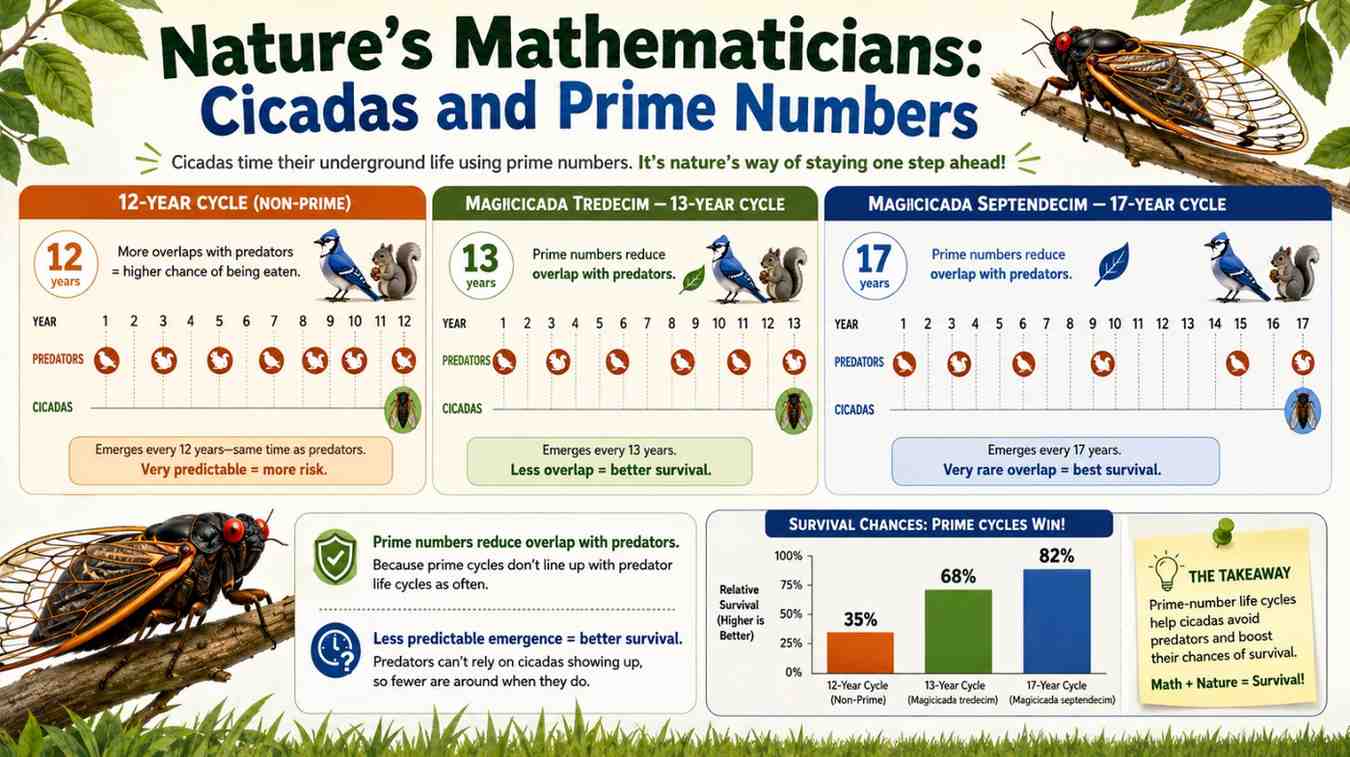
Mathematics finds its place beyond blackboards and worksheets. Here’s a surprising yet interesting space where it finds expression. Can you believe this hidden math in nature? It hums, hides underground, waits for years and then emerges with a sound loud enough to fill the air.
The cicada is an extraordinary insect, known for its deafening rattle and often described as one of the loudest insects in the world. Among more than 3,000 species of cicadas, two particularly fascinating ones are Magicicada septendecim and Magicicada tredecim. Found primarily in North America, these species are known for their unusually long life cycles — and their surprising connection with prime numbers.
When cicadas emerge from the ground, they are vulnerable. Birds, squirrels, cats, turtles, fish, spiders and even humans may become their predators. So how do these insects improve their chances of survival? Their secret lies in timing.
Unlike many species that emerge every one or two years, Magicicada tredecim emerges every 13 years, while Magicicada septendecim emerges every 17 years. Both 13 and 17 are prime numbers. This helps cicadas avoid synchronising too often with the life cycles of their predators, making it harder for predators to predict when they will appear. As shown in the accompanying bar chart, a prime-number life cycle can significantly improve their chances of survival.
Prime numbers are divisible only by 1 and themselves. This means an insect with a prime-number life cycle is less likely to emerge at the same time as predators with shorter, repeating life cycles.
For example, if a cicada had a 12-year life cycle, predators with life cycles of 1, 2, 3, 4, 6 or 12 years could intercept it more frequently because all these numbers are factors of 12. A predator with a 2-year life cycle would meet the cicada every 12 years. A predator with a 4-year life cycle would also overlap with it regularly.
But a 13-year cicada changes the game. A predator with a 2-year life cycle would meet it only every 26 years, while one with a 4-year cycle would overlap only every 52 years. That is a major difference. Because 13 is prime, it does not easily fall into step with the cycles of many predators.
This fascinating connection between cicadas and prime numbers shows how mathematics can appear in the most unexpected places.
Here’s what we can ponder over: is this mere coincidence, or are cicadas nature’s true mathematicians?
That may be one puzzle we will keep wondering about for long.